
Checking Criminal History in Clayton County
Start with the free Clayton JIS Court Case Inquiry when the goal is to learn whether a local criminal case was filed and how it ended. Its criminal name search covers Superior, State, and Magistrate courts. Search all courts when the venue is unknown. Results show a role, name, birth year, abbreviated offense, filing date, case number, status, and judge. Birth year helps separate common names, but it is not proof of identity.
A careful Clayton County criminal record check follows the record from summary to source. The docket should be read through its final event, since an arrest charge or first filing may differ from the outcome. Certified copies and older images still come from the proper clerk.
- Choose All Courts or the known Clayton County court, then enter the surname and any useful first name or initial.
- Compare birth year, filing date, charge, court, and judge before treating a row as the right person.
- Open the linked case number and read the counts and chronological docket through the final disposition.
- Check current custody separately in the jail portal, because booking data does not prove a court outcome.
- Ask the correct clerk for certification, archived images, or an official explanation of a missing file.
Clayton Criminal Records at Banke
The Harold R. Banke Justice Center directory explains a local source of confusion. The secure complex at 9151 Tara Boulevard in Jonesboro combines the detention center, sheriff headquarters, eighteen courtrooms, and several court clerks. One address does not mean one records counter. Felony court files go to Superior Court Criminal Division in Room 1CL19 at (770) 477-3405. State misdemeanors use the State Court Criminal Division, while older State Court material may require Microfilm in Room 1CL191 at (678) 479-5520.
The county's own directory shows how the records offices fit together.
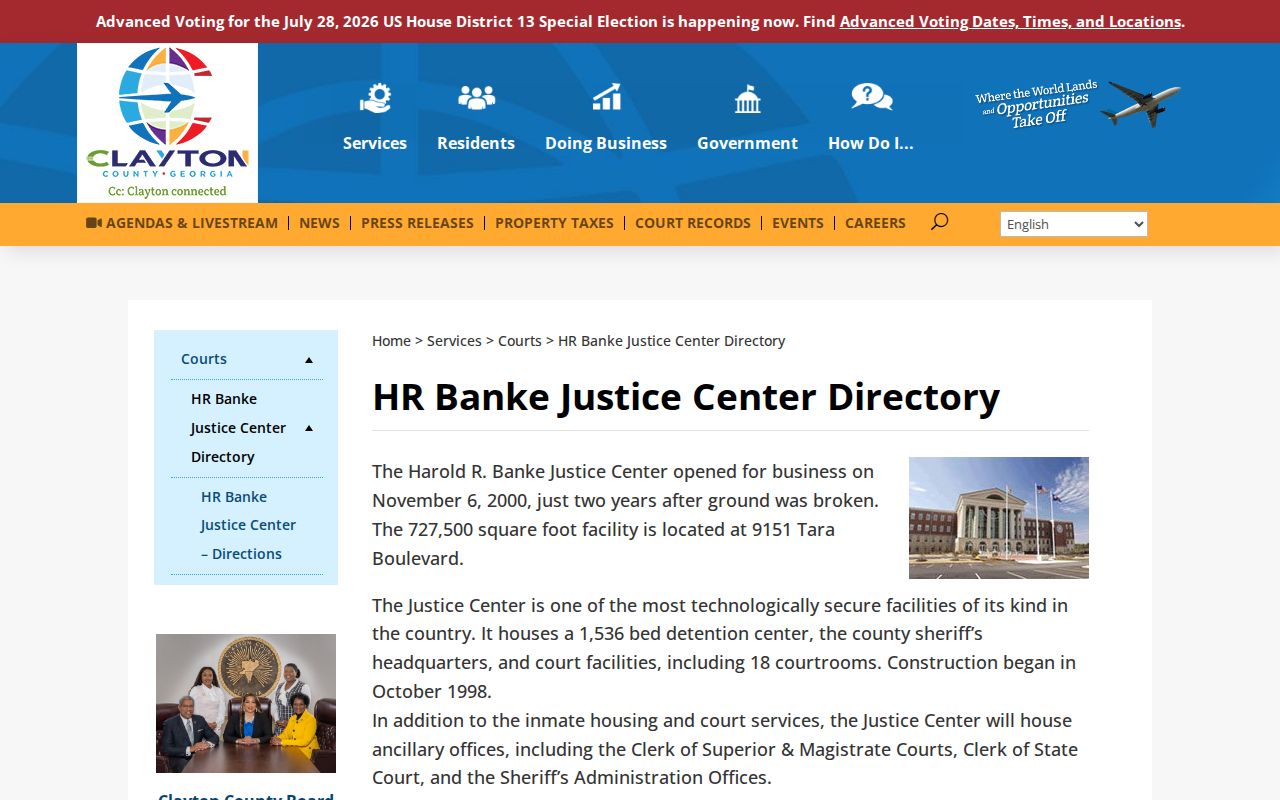
The image reinforces why a case, warrant question, and booking inquiry can require three different custodians inside the same Clayton County complex.
Superior Court Criminal Division
9151 Tara Boulevard, Room 1CL19
Jonesboro, GA 30236
(770) 477-3405
Sheriff Records
Visitor entrance, 9157 Tara Boulevard
Jonesboro, GA 30236
(770) 477-4404
Clayton County Police Records
7911 North McDonough Street
Jonesboro, GA 30236
(770) 477-3747, option 1
Note: Call before visiting because official sources use 9151 for the justice complex and 9157 for the sheriff visitor entrance.
Georgia Official Background Checks
Georgia Felon Search is the public name-based product from the Georgia Bureau of Investigation and Georgia Crime Information Center. It asks for first and last name, exact date of birth, sex, and payment. Each selected possible record or no-record response costs $15. It does not include misdemeanors, juvenile felony history, sealed or restricted information, federal records, or records from other states. Multiple possible matches can also mean multiple charges, so the product is not fingerprint-confirmed identity.
The official Georgia information screen sets out those limits.
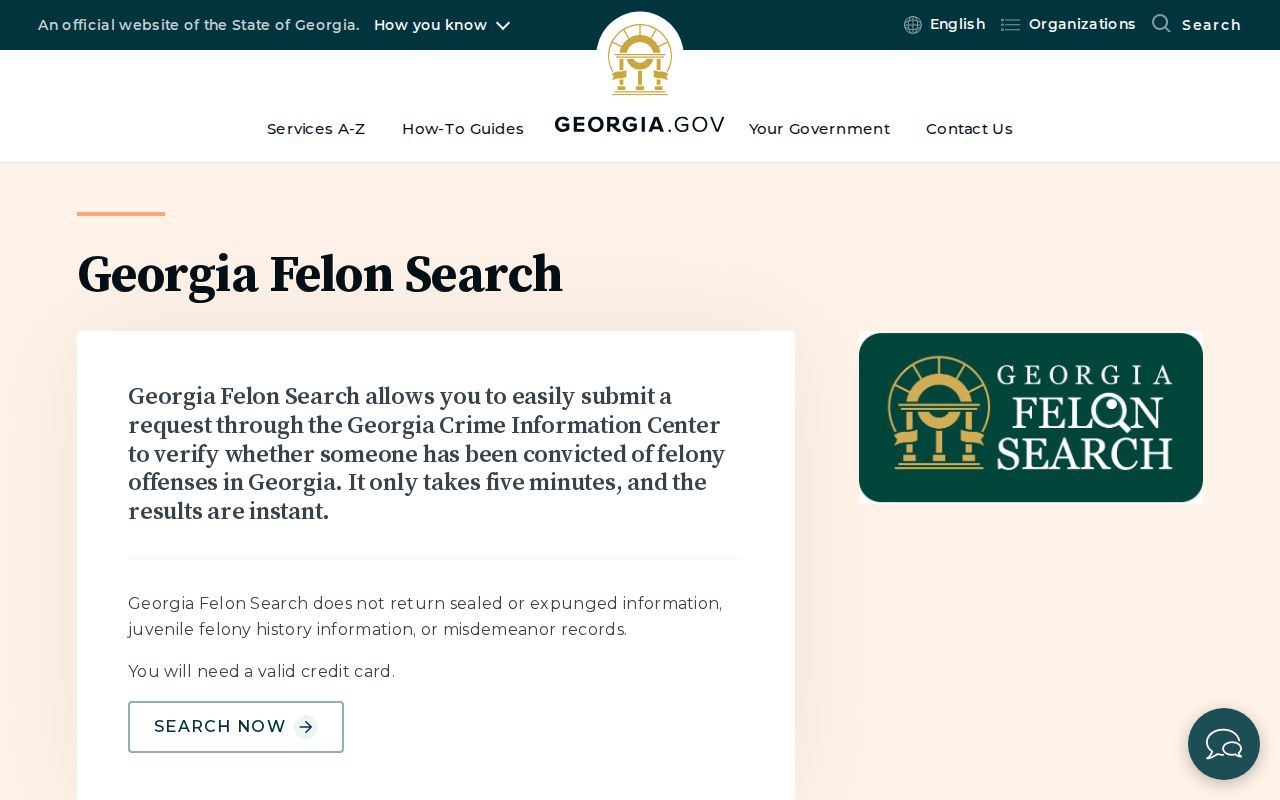
The screen is best used as a statewide felony-conviction layer after checking the more detailed Clayton County court docket.
| Official route | Scope | Key limit |
|---|---|---|
| Clayton JIS | Local court cases and docket events | Omits sealed, juvenile, pre-JIS, and other restricted matters |
| Georgia Felon Search | Public Georgia felony convictions | $15 per chosen result or no-record response |
| GAPS fingerprints | Personal review or a legally authorized fingerprint check | Needs the correct service code and photo ID |
Clayton Records Through GAPS
For review of one's own fuller Georgia record, or another check specifically authorized by law, use Georgia Applicant Processing Service through IdentoGO. Registration begins with the agency's service code. The applicant then chooses a live location and brings valid photo identification. GCIC says an authorized agency usually receives results within 24 to 48 hours after fingerprints are submitted. The live locator should be used instead of relying on an unverified Clayton County storefront.
The GAPS registration page shows the current entry route and location finder.
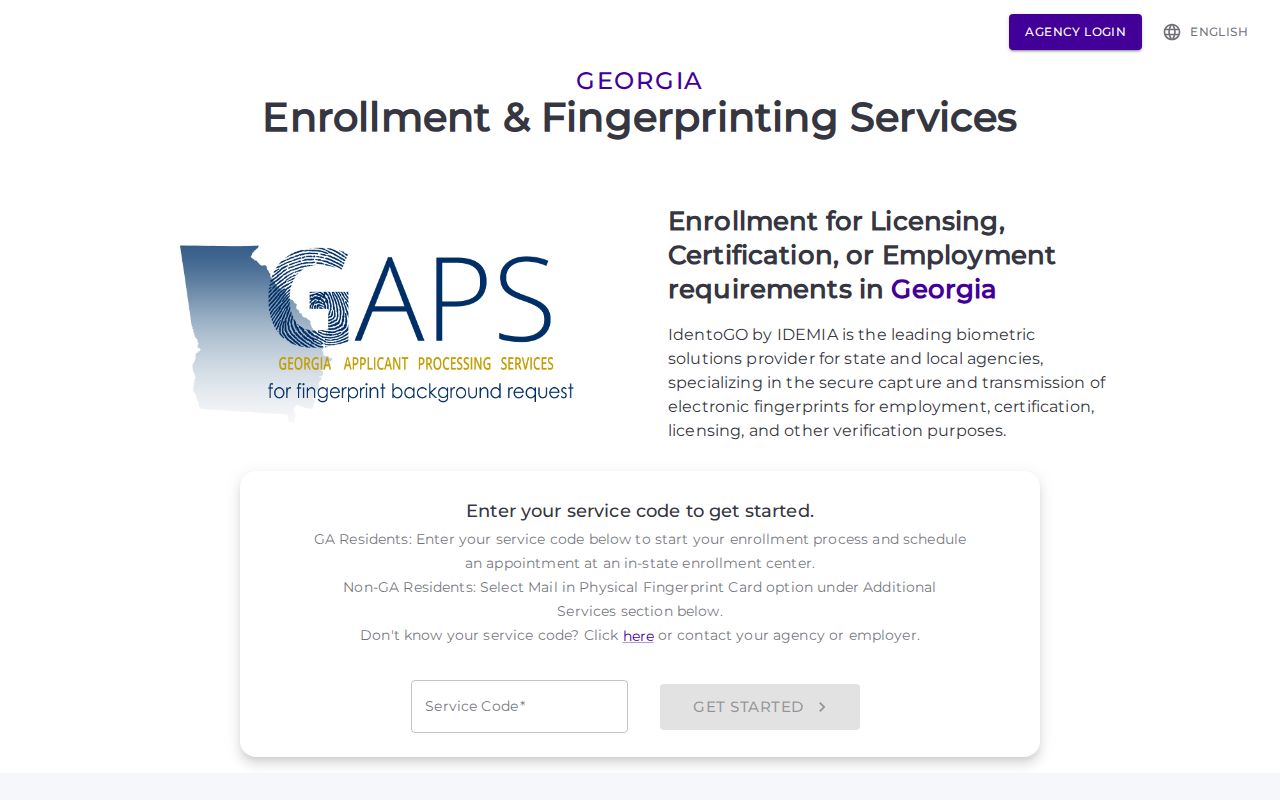
Fingerprints tie the request to identity in a way that a Clayton County name result or Georgia Felon Search match cannot.
| GAPS service | State base | Total listed fee |
|---|---|---|
| State only | $30 | $39.99 |
| Georgia and FBI | $42 | $51.99 |
| Volunteer state only | $28 | $37.99 |
| Volunteer Georgia and FBI | $38 | $47.99 |
Criminal Record Types
Clayton County criminal records are separate products. Police create incident and arrest narratives. The jail creates custody and booking rows. Prosecutors file accusations or indictments, and clerks preserve court events and dispositions. GCIC assembles reported Georgia cycles. The Department of Community Supervision keeps adult felony probation and parole information, while the Georgia Department of Corrections covers state prison custody.
- Arrest and incident reports describe the event and initial allegations from the arresting agency.
- Booking records show intake, charge, bond language, and current or recent custody.
- Court files show filed counts, motions, pleas, events, disposition, and sentence when recorded.
- Repository history joins identification, arrests, reported outcomes, and Georgia custody cycles.
- Warrant records begin with the issuing court and later appear with the executing agency when served.
The dedicated Clayton County arrest lookup distinguishes booking data from the arresting agency's narrative and later court record.
Three Clayton Criminal Record Clocks
Booking, prosecution, and repository reporting do not move at the same pace. The booking clock starts at jail intake and may place a person in the 48-hour docket book. The prosecution clock begins when a prosecutor files a charge in court, and that filed count may differ from the arrest allegation. The repository clock depends on police, prosecutors, clerks, and supervision agencies sending updates to GCIC.
That timing explains why a new Clayton County booking may have no court result yet. It also explains why a dismissed local docket can coexist for a time with an incomplete state cycle. After release, a person may vanish from active-inmate results even though the agency report and court file remain. Treat each source as a dated view, not as a substitute for the others.
If a Clayton County disposition has not reached GCIC, obtain the certified outcome from the clerk before asking for a correction. GCIC cannot decide on its own that a supplying agency's entry is wrong. The contributor must update the arrest or identification data, or authorize the change with enough identifiers to locate the cycle. A written agency request can use the state identification number or offender tracking number with the arrest date. This makes the local court outcome the key proof when the repository history lags.
Arrest → Booking → Prosecutor review → Court filing → Disposition → GCIC update
Inside a Clayton County Criminal Record
A Clayton JIS case can include the case number, judge, filing and status dates, parties, attorneys, counts, offense text, docket events, final disposition, and event outcome. The public result list reduces date of birth to birth year. It does not display a Social Security number or state identification number. GCIC's complete criminal-history model can be broader, while the public Georgia Felon Search slice is narrower.
| Name and identifiers | Name, aliases when supplied, and limited public identity details such as birth year. |
|---|---|
| Arrest or booking data | Creating agency, arrest date, initial charge, docket number, custody, and bond display where available. |
| Charges and statutes | Filed count, offense label, accusation or indictment information, and cited law. |
| Disposition | Outcome such as dismissal, no bill, plea, conviction, or acquittal when entered. |
| Sentence | Court-ordered custody, supervision, fine, or restitution when public and recorded. |
| Custody or supervision | County jail, state prison, probation, or parole information held in separate systems. |
Clayton Jail and Prison Searches
Clayton County's free jail portal covers active inmates and recent 48-hour, 14-day, and 31-day docket books. A row may show docket number, name, age, charge, bond amount, and status language. Several rows can belong to one person because the display is charge-based. READY, HOLDS, Not Eligible, and No Amount Set are custody or bond displays, not findings of guilt. Call jail information at (770) 477-4400 before acting on a bond line because amounts and added fees can change.
For a person transferred to state prison, use GDC Find an Offender.
The state locator is not a substitute for the Clayton County jail roster, and neither one supplies the complete court disposition.
Public Access Laws in Georgia
Access depends on the custodian and the type of Clayton County criminal record. Georgia's open-records law supports requests to agencies, yet redaction, active-investigation limits, juvenile confidentiality, and sealing still apply. A public name match does not establish identity, and an arrest record does not establish guilt. Request the police narrative from its creator, custody status from the jail, filings from the correct clerk, and statewide reported history from GCIC.
Key Georgia laws:
O.C.G.A. § 50-18-71 sets the ordinary three-business-day response or production-time statement under the Georgia Open Records Act.
O.C.G.A. § 35-3-34(d.2) permits the defined public felony-conviction search without the subject's consent.
O.C.G.A. § 35-3-37 governs eligible Georgia arrest-record restriction.
O.C.G.A. § 42-1-12 governs sex-offender registration, reporting, and public registry operation.
Clayton GovQA Document Requests
Use the county's GovQA open-records portal when no direct database supplies the needed county document. A strong request names the agency, incident or case number, date range, record type, desired format, and whether certification is needed. The three-business-day rule is a response rule. For a large or archived request, the county may state when and how production will occur rather than complete it within that period.
The county's portal is the formal electronic fallback.
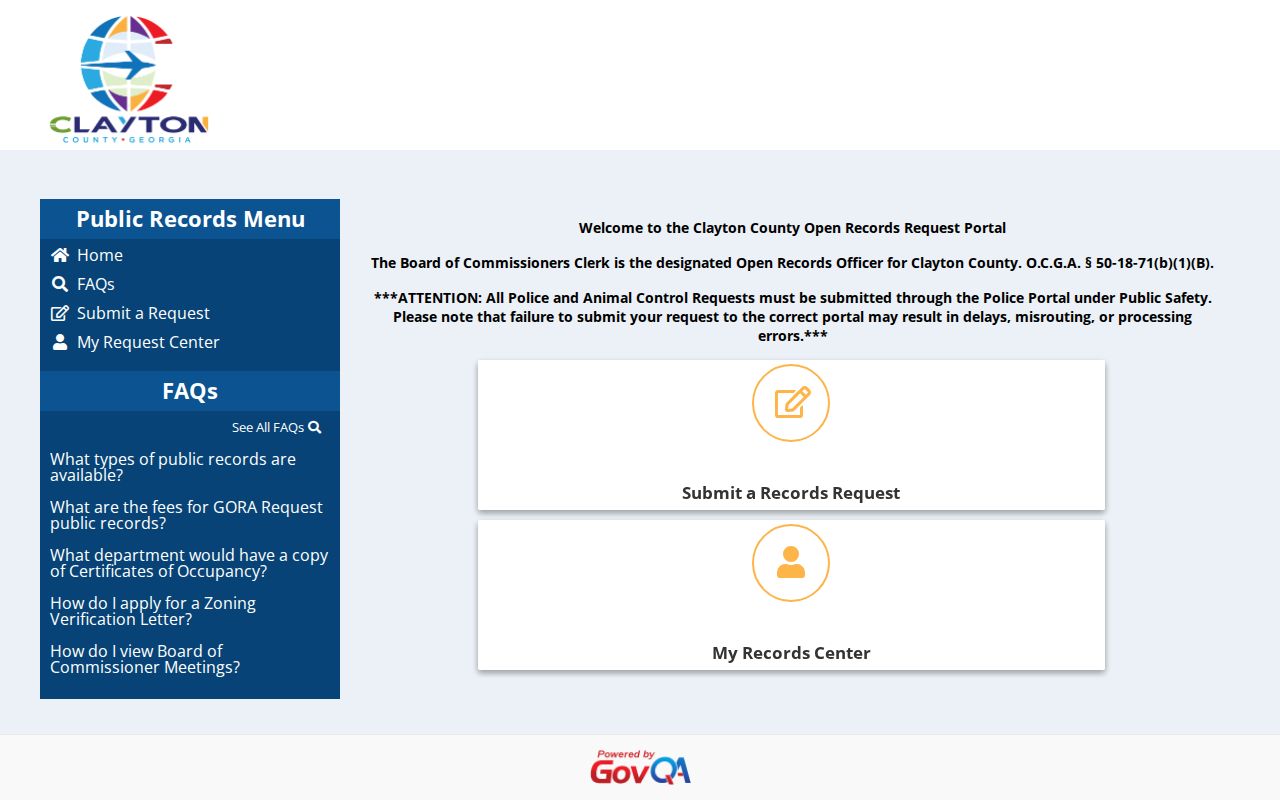
Direct clerk or police contact remains faster when the correct custodian is already known.
Sealed, Expunged, and Restricted Records
Georgia uses the term record restriction under O.C.G.A. § 35-3-37. It is not the same as wiping every source. For an arrest after July 1, 2013, GBI directs the applicant to the prosecutor. For an older arrest, the paper request moves through the arresting agency and prosecutor before submission to GCIC with its $25 processing payment. Potential outcomes include dismissal, no presentation to a grand jury, no further action anticipated, nolle prosequi, dead docket, and no record on file. Eligibility remains case-specific.
Court sealing and First Offender discharge are separate routes. A missing disposition is first a correction issue: obtain the certified outcome and ask the originating court or prosecutor to report it. Restriction changes dissemination, while sealing limits ordinary access to an eligible court file. Clayton JIS also excludes juvenile, sealed, protective-order, pre-JIS, and other restricted matters, so no result never proves that no record exists.
For Clayton County criminal records, the order of work matters. First compare the public docket with a personal GCIC history. Next obtain the final disposition from the clerk if it is missing or wrong. Then ask the contributor to send the correction. Only after the data is sound should an eligible person use the restriction, sealing, or First Offender route that fits the case. Georgia formerly used the word expungement, but current official instructions call the repository remedy record restriction.
- No bill
- A grand jury declined to return an indictment.
- Nolle prosequi
- The prosecutor ended the charge.
- Disposition
- The recorded outcome of a charge or case.
- Record restriction
- A Georgia limit on criminal-history dissemination, not automatic destruction of every copy.
Clayton Record Restriction Assistance
Clayton County held its second annual misdemeanor record-restriction event at Riverdale Town Center on July 12, 2025. The official event offered walk-in help with eligible misdemeanor matters. That local effort matters because a court disposition, GCIC restriction, sealing order, and First Offender discharge solve different problems. A reader should review the current Clayton docket and personal Georgia history before choosing a remedy.
Event assistance does not create automatic eligibility. Current options, dates, and required documents should be confirmed through the official Clayton Second Chance site and the office responsible for the case.
Who Holds Clayton Criminal Records
Clayton County Police serves unincorporated areas, while Forest Park, Riverdale, Lovejoy, Jonesboro, Morrow, and Lake City have their own police departments. A city officer's narrative stays with that city even when the person later appears in the county detention portal. The sheriff keeps booking and custody data. Superior Court holds felony files, State Court handles county misdemeanors, and city municipal courts retain matters within their narrower jurisdiction.
Magistrate Court is another distinct stop for warrants and early or preliminary matters. The District Attorney handles felony prosecution, while the Solicitor General handles State Court misdemeanors. Adult felony probation and parole supervision runs through the Georgia Department of Community Supervision. Misdemeanor probation may use a government or private provider, so the sentencing court is the sound place to confirm who holds that supervision record.
The Clayton County government directory provides the main route to county departments.
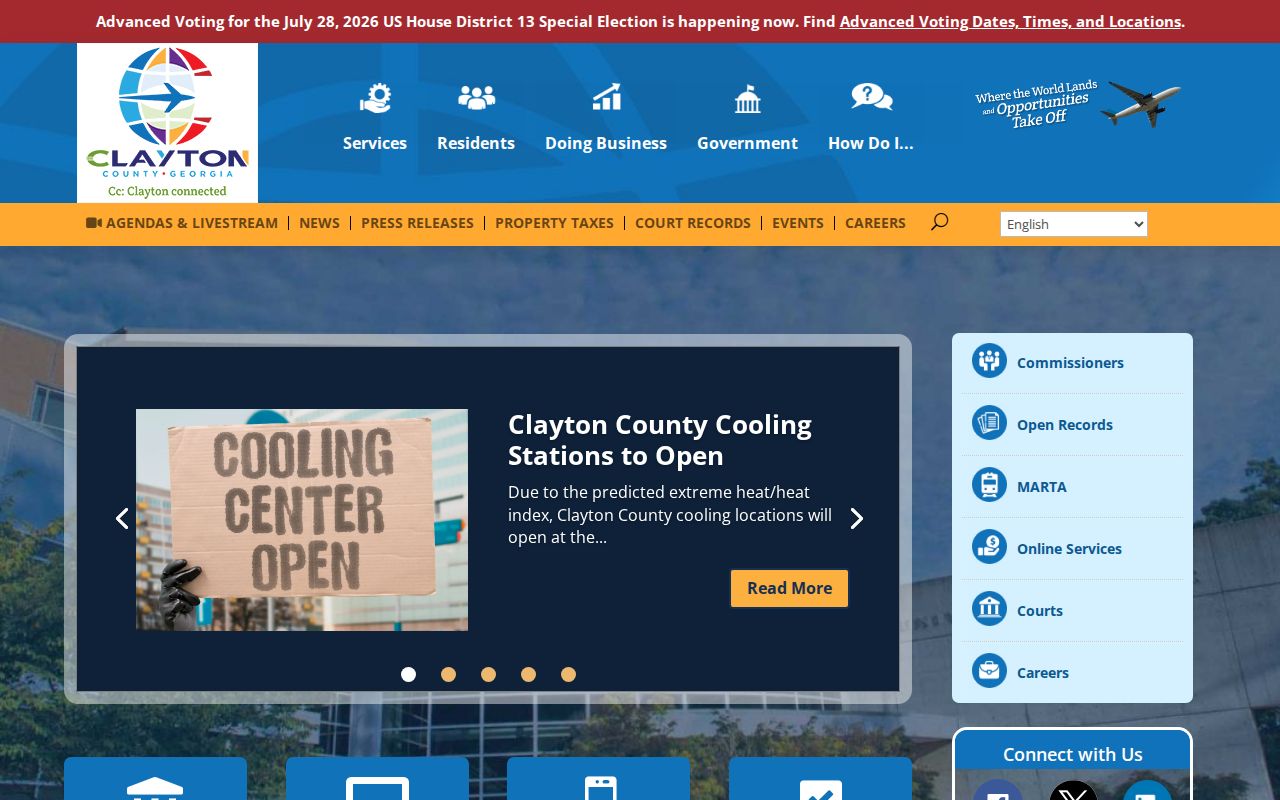
Identify the arresting agency from the report, jail row, or case before sending a request, since asking the sheriff for a city police narrative can miss the actual custodian.
Clayton County Criminal Records by City
Forest Park, Riverdale, and Lovejoy are the county's three largest incorporated cities by the official 2024 estimates used in the research. Their police records channels, municipal court schedules, fees, and request portals differ. City pages keep those local steps distinct while routing felony case files and county custody questions to Clayton County.
Forest Park Criminal Records
Population 19,301. Police requests use JustFOIA, while Municipal Court publishes separate calendars and session rules.
Riverdale Criminal Records
Population 14,586. Police records, JustFOIA requests, and the Municipal Court counter have distinct schedules.
Lovejoy Criminal Records
Population 12,612. Police records include a paid report route, and Courtware supplies city docket links.